


If you’re a moviegoer, and your friends are moviegoers, I promise you this week that one of you is going suggest that you all go see the new film Hereafter.
Hereafter is the new film from the venerable Clint Eastwood, which of course makes it An Important Movie. Which means when you walk in and plop down your $15, you’re going to expect that it’s a serious treatment of its subject – that is, Near Death Experiences.
And I’m not here to tell you not to see it. It’s reasonably well told, and full of attractive people. But I do want to warn you that the movie isn’t really about near-death experiences. The movie isn’t the least bit interested in near-death experiences. In case that matters to you, I’ll save you your $15 right now and tell you what Hereafter is about:
It’s about Matt Damon really, really needing to get laid.
I’m not kidding. Every death in the movie – from a senseless traffic fatality in London to the ghastly carnage brought about by the December 26, 2004 Indian Ocean tsunami – simply serves as a mechanism to help Matt Damon finally solve his romance troubles.

Matt Damon stars as a glum guy who used to be a successful professional psychic. Sort of like John Edwards, except a) his talent is real, meaning he’s not b) a reprehensible scum-of-the-earth creep. He’s just lonely and sad, as only good-looking movie stars can be.
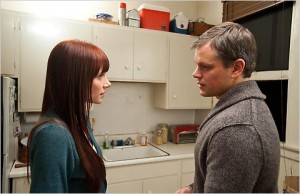
His psychic gift became such a burden that he gave it up, and he now plods through a depressing factory job at the S&H Sugar factory in San Francisco. But his gift stubbornly haunts him, and once again ruins his chance at love with a beautiful and available fellow cooking student (the always-welcome and puzzlingly underrated Bryce Dallas Howard).
Meanwhile, two other seemingly deeply meaning-filled stories develop elsewhere in the movie. In once, a famous French journalist (the arrestingly beautiful Cécile de France) struggles to come to grips with the near-death experience she had during the tsunami (which is depicted quite impressively). In the other, a young English boy (played by both Charlie and Frankie McClaren) struggles to come to grips with the abrupt death of his twin.
The movie is never boring, but it’s sloppy. Eastwood is famous for working quickly, but this time I think everyone went a bit too quickly. There’s a howling mistake during a scene in which Damon is touring the home of Charles Dickens. Damon’s character is a Dickens freak, so it’s fun to watch him whisper the answers to every trivia question about the great writer asked by the unctuous tour guide. Therefore, when the guide makes a stunningly basic mistake about Dickensian lore (the subject of Dickens’ last novel was named Edwin not Edward Drood) it makes absolutely no sense that Damon wouldn’t react. But he doesn’t . . . I’m assuming because the mistake was unintentional, and Mr. Eastwood said “Cut! Print!” before any literate person on the set had a chance to raise her hand and say, “Ahem, actually the book was called . . . “

Even worse, Eastwood succumbs to one of the biggest clichés in the history of movies – a chestnut that’s been endlessly lampooned in those lists that circulate on the internet: the old Eiffel Tower Through The Window So You Don’t Forget You’re in Paris shot. Honestly, Clint . . . you didn’t fall off the turnip truck yesterday, and for that matter neither did we, so how could you foist that clunker on us? It’s embarrassing, really.
But back to the plot! Since this is a Big Important Movie, it’s easy to get seduced into believing that all three stories will eventually come together in some meaningful and illuminating way.
And they do come together in act three. Huzzah!
And guess what we learn about the hereafter?
Nothing. Absolutely nothing.
That big a fool Clint Eastwood isn’t. He knows that what lies beyond the veil of death is one of life’s unknowable mysteries, and that to pretend to know otherwise is an invitation to ridicule. It’s a bit shocking to think that this movie was written by the gifted Peter Morgan, who penned Frost/Nixon and The Queen, which were both actual adult movies, and good ones.
So why, then, make this movie? Why dangle this big, tantalizing topic in front of us when you know there are no real answers to be had? The more I think about it, the more offensive it is. I hate to say it, but Hereafter reminds me of the loathsome Awakenings (1990), which pretended to be about catatonic encephalitis victims and their failure to have long-term benefits from an experimental treatment, but in the end it turned out it was really about Robin Williams getting to have sex with Julie Kavner. Yippee, happy ending! I remember sitting in my seat twenty years ago in slack-jawed disbelief, half-expecting Robin and Julie to roll the once-again unresponsive Robert DeNiro off his gurney so the they could use it to get busy.
Hereafter is that distasteful, because its message is the following: Don’t feel bad that your twin got creamed by that truck, and don’t think that the deaths of those 200, 000 brown people in the tsunami were in vain! All that happened for a really good reason: Two lonely, attractive white people finally get laid!
